
Theme #4: Yordan is Really Awesome at the Plate. The Problem is All the Other At Bats
The Astros have an above average offense this season. Most of that is due to Yordan Alvarez being the best hitter in the AL. But the offense lacks depth in the bottom half of the order.

There is good news and bad news when it comes to the Astros offense in 2026. The first bit of good news is that it’s not godawful like the team’s pitching is. In fact, it is an above average offense. The Astros are scoring runs and hitting for power; they are sitting firmly in the top half of MLB teams across almost every major statistical category. It looks like the machine is humming along as it always does.
The good news about the Astros offense is that back in 2016, the Dodgers thought they needed Josh Fields to round out their bullpen as they pushed for the playoffs that season. In exchange—come on, you know who the Astros got in exchange. As Jules often writes on social media:
The bad news is that the offense as a whole is propped up heavily by Alvarez’s massive contributions this season. This isn’t a balanced, deep, multi-layered offensive juggernaut anymore. It’s a house of cards. Some others are making contributions—but the whole offense is propped up by Yordan Alvarez.
Let’s start by looking at the macro picture. If we look at the team’s overall metrics, the aggregate numbers paint a picture of an above average MLB offense:
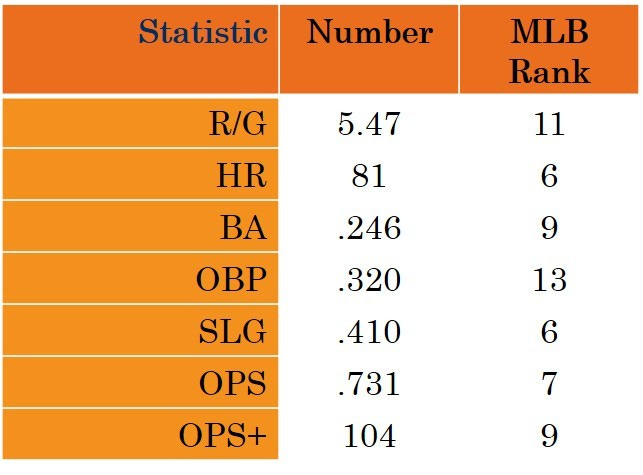
The Astros are 11th in the majors in runs scored per game at 5.47. They probably should be a little higher in run scoring. The Astros are 6th highest in home runs and slugging, 7th in overall OPS, and 9th in team OPS+. These are all objectively good numbers in the context of 2026 baseball.1 The team does not walk as much as ideal (their 8.7% walk rate is 21st best in the majors), but they make up for that with big power; they are 7th in majors in isolated power at .165.2
But as I have framed this piece, all this good news about the offense is also met by some bad news. If you break down who is contributing to the team’s offense, one man stands out—Yordan Alvarez. As for everyone else…well, that’s a different story.
The Lone Titan and the Supporting Cast
The chart below shows the individual OPS+ for each prominent member of the Astros lineup this season. OPS+ takes OPS (On base Plus Slugging percentage), adjusts for park effects, and then normalizes the scale. 100 is exactly league average, and each unit above or below 100 is one percent better (or worse) than league average.
As a team, the Astros have a 104 OPS+, which means they are 4% better than league average. In the chart below, the dashed line shows that number.
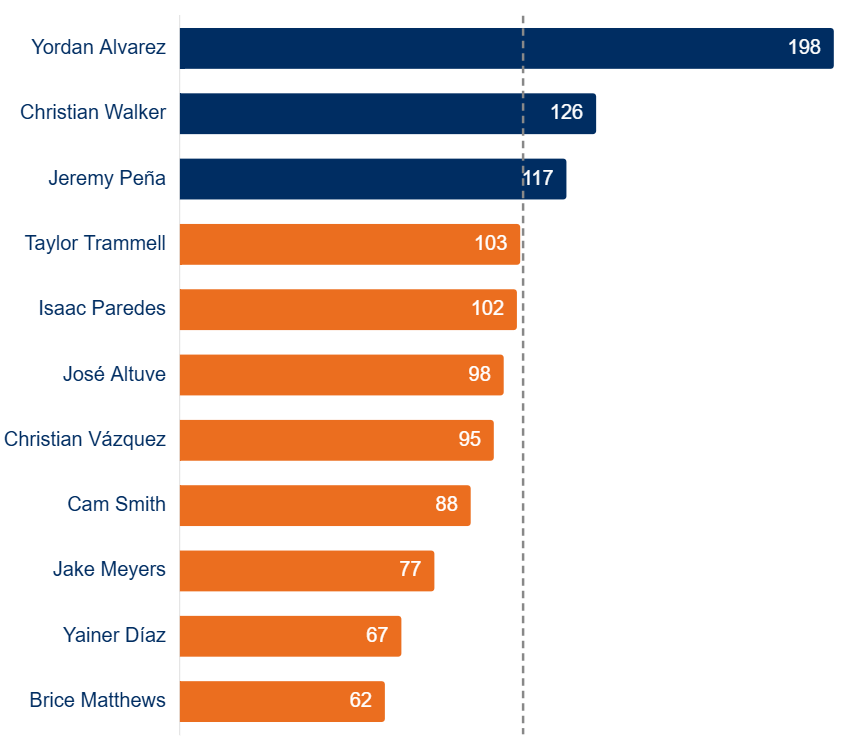
Yordan Alvarez is sporting a mind-boggling 198 OPS+. He is effectively playing twice as well as a league-average major league hitter. The league average hitter is slashing .242/.319/.393. Alvarez is slashing .316/.428/.649. His batting average and slugging percentage are tops in the league, and he also leads the AL in home runs and OPS. He is lagging in on base percentage—he’s second in the AL behind Nick Kurtz of the A’s.
But if you look at the chart above, it shows that Alvarez is almost single-handedly pulling the Astros team average to the right (i.e. the good direction in this chart).
Alvarez is not full alone. Christian Walker has had a bounce back campaign, posting a 126 OPS+. He is also providing essential help to the lineup, and the inability of the front office to trade him this offseason for salary relief has actually paid off for the Astros.
Jeremy Pena has also been an offensive plus. He is slashing .298/.351/.433 for a 117 OPS+. Of course, that good news is tempered with bad news. Pena has been able to play in only 26 of the team’s 64 games this season due to injury.
But shockingly, only three Astros hitters are above the team’s average of 104 in OPS+.
The Drop-Off to the Underbelly
Most Astros hitters this season are clustered at or near league average.
Taylor Trammell (103) and Isaac Paredes (102) hover just above the league average mark. That’s a surprisingly good mark for Trammell (career OPS+ of 82) and a surprisingly poor mark for Paredes (career OPS+ of 114).
From there, it gets progressively worse:
Christian Vázquez (95 OPS+): This is actually a surprisingly good number for Vazquez, who had a 60 OPS+ in his three seasons in Minnesota.
Cam Smith (88 OPS+): A young player struggling to create value with his bat; he stays in the lineup for his glove.
Jake Meyers (77 OPS+): This is Meyers’ worst offensive season since he lost his job and MLB roster spot in 2022.
Yainer Díaz (67 OPS+): A shocking regression that has completely sapped the lineup of its expected catching depth.
Brice Matthews (62 OPS+): Completely overmatched at this stage, offering almost no offensive utility.
In short, the Astros have a lot of unproductive at bats in the bottom half of the lineup every game. That’s when you can go to the kitchen to get another beer. You’ll also need a beer or four to watch these at bats.
A Yordan Dependent Offense
In the first 19 days of May, the Astros slumped offensively. They averaged 2.6 runs per game—less than half of their total across the entire season. Why did the team slump so much offensively? Well, during those 19 games, Yordan Alvarez slashed .209/.321/.373.
The Astros offense in 2026 is going as far as Yordan Alvarez can take them. When Alvarez slumped, so did the entire offense. When he is hot—like he has been for the periods outside of those 19 games in early May—he can prop up this entire offense.
Alvarez has been the best hitter in the American League in 2026. We are privileged to watch him hit.
But the overall Astros offense this season is dragged down by a set of hitters that lack overall depth. The team runs out four or five below average hitters in its lineup most nights. More depth is needed from the bottom half of the lineup.
But even without that, we get to watch Yordan Alvarez every night. And that’s pretty awesome.
Yes, a .246 batting average is above average. The league is hitting .242. Pitchers are witches, as their ability to increase velocity and design new pitches has overwhelmed the ability of the best hitters in the world to hit singles.
Isolated power is slugging percentage minus batting average. It “isolates” how well a team is hitting for power, as opposed to boosting its slugging percentage by having a high batting average.
On your OPS+ chart, it really looks solid through Christian Vazquez. Who is, after all, our backup catcher. Who said we couldn't replace max value Caratini?
And a 98 from your contractually-obligated fading Hall of Famer ain't bad either.
And you can make the case that both 'Tuve and Isaac will bump their numbers up the rest of the way.
But three BIG problems:
Cam - A wonder defensively, but not as cool as Jake Marisnick and about the same offensively. Game winning triple the other night notwithstanding he's an 8th and 9th inning defensive replacement given 5 PAs per game. The patience TK and Blummer have shown with him makes me incredulous. Just say it! He has not been good!
Yainer - What happened? This guy was gonna be awesome! The feeling I get is that the Astros don't really care when or if he gets back. 2 years ago that would have been inconceivable.
Jake - Another amazing defender if you gloss over his arm, but this was the year where he was supposed to take off, after last year's major boost to BA. The guy was a sparkplug in the minors and we got a glimpse last year, I thought, of what he can be. But bupkus so far this year.
I think (and it for sure ain't no conceptual breakthrough) that if Yordan can just stay healthy he will win the MVP going away. But I'm still scared. This is a guy who injured himself trying to plant his foot on a slippery home plate. Is he star-crossed or just made of glass?