
The Astros Value Walker and Paredes More Than Other Teams...It's Why They Haven't Traded Them
Or Why We're Close to Yordan Alvarez in Left Field on Opening Day.

The Astros have tried to trade Christian Walker this offseason and have been unsuccessful in doing so.
The Astros have tried to trade Isaac Paredes this offseason and have been unsuccessful in doing so.
The basic reason for this is very simple—the Astros value Walker and Paredes more than do other teams in baseball. As a result, Dana Brown has not found a deal that he likes for either player. While it’s good that Dana Brown is holding the value for his players, the Astros are rapidly moving towards an Opening Day lineup where Walker and Paredes are both in the lineup—and Yordan Alvarez starts the season as the team’s left fielder.
Today, I’ll discuss why the Astros value Walker and Paredes, why other teams value them less, and the plusses and minuses of a lineup that features Carlos Correa at third base, Walker at first, Paredes at designated hitter, and Alvarez in left field.
Why The Astros Value Their Players
Dana Brown’s front office sought out both Walker and Paredes last season to fill specific holes on the team.
Walker would address the team’s long-time hole at first base. The Astros had been searching for a first baseman every since Father Time overtook Yuli Gurriel’s quick hands in 2022. But neither Gurriel, Trey Mancini, nor Jose Abreu were able to provide useful offensive or defensive skills at first base. Walker, a Gold Glove defender with good power, was supposed to do that in 2025, but had a dreadful first half of the season.
The Astros would be happy to deal Walker, and have made him available in trade talks. Undoubtedly, those talks have focused on how much of the 2 years and $40 million left on Walker’s contract the Astros are willing to pay another team to take him off of their hands.
The Astros are certainly willing to pay some of Walker’s salary, but Walker looked like a better player in the second half of the 2025 season, posting a .799 OPS after the all Star break. The Astros think there is something of a good player in there. As such, the Astros do not want to pay all of the $40 million the owe to Walker. Why pay a player to provide value for another team?
Paredes was acquired not only to fill the third base slot left by the free agent departure of Alex Bregman, but also to replace Bregman’s role as a player who wore out opposing pitchers with discerning swing decisions and to take advantage of mistakes with a pulled fly ball swing that send balls into the Crawford Boxes. The Astros had targeted Paredes for a while because they thought his swing was particularly build for Daiken Park. Paredes’s 20 homers in 102 games last season indicated that they are correct.
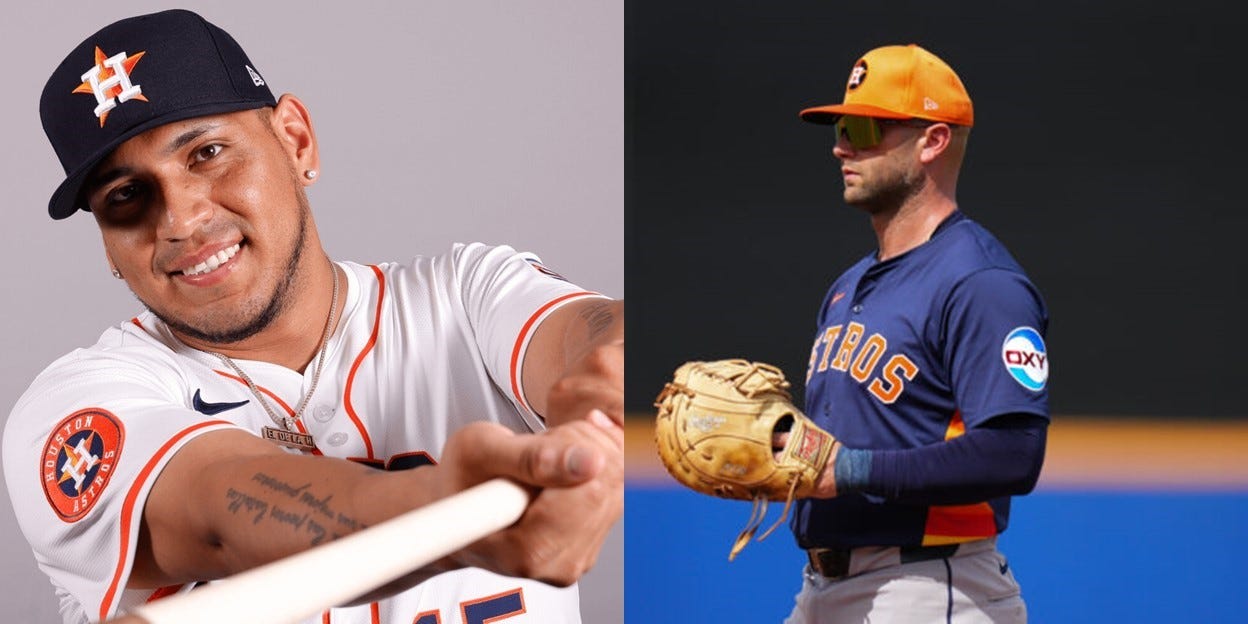
Why Other Teams Value Walker and Paredes Less
The good news for other major league teams is that they almost certainly don’t have to give up any viable prospect to get Walker in a trade from the Astros. They just need to be able to take on a large share of his contract. In that sense, he is essentially a free agent signing. And other teams would rather just sign a free agent than trade for Walker.
Three first baseman have signed one-year contracts this offseason, which is essentially the same pool that Walker is in after his 2025 season. The Yankees signed Paul Goldschmidt to a 1 year/$8.9 million contract. But Goldschmidt was re-signing with the teams they has played with in 2025. The Yankees may have evaluated Goldschmidt as better baseball players than Walker at this point. But it seems close to certain they regarded them as better fits in their clubhouses. Their guys already liked these guys.
The two other free agent first basemen who signed were Josh Bell, who signed a $7 million deal with the Twins, and Carlos Santana, who signed a $2 million deal with the Diamondbacks. Both of these teams seemed to be candidates to take on Walker earlier in the offseason, but they chose to take on these free agents instead. Why a free agent? Those contracts are pretty cheap, and the difference between these players and Walker is pretty negligible. For example, Bell is projected to slash .252/.336/.420 by the Depth Charts projection at Fangraphs. Walker is projected to slash .231/.306/.432. So worse on base and better slugging. Walker is projected for better defense, but I don’t think too many Twins fans are aghast their front office chose Bell over Walker.
There is a second complication for trading Walker. I just compared Walker to other first basemen who signed one-year free agent contracts. But Walker is under contract for two seasons. Budget conscious team—and the cost-cutting Twins are certainly one of those—prefer not to pay players not on their team. If Walker is close to done, the Twins or Diamondbacks don’t want to carry a salary in 2027. Thus, the one year deals for Santana and Bell.
For Paredes, other teams value him less than the Astros do because they lack short left field provided by the Crawford Boxes. Paredes led the majors in 2025 in the share of balls that he pulled and the share of balls that he pulled into the air. This allows for Paredes to be a home run threat despite not hitting the ball very hard—he was in the 14th percentile in both exit velocity and hard-hit rate in among all major leaguers in 2025; he finished in the 20th percentile in barrel rate. Paredes has the most unique swing in the majors, sending as many fly balls as possible into left field. Having a short left field porch maximizes Paredes’ value. You can see this from his home run chart last year (below), all of which went to left field.
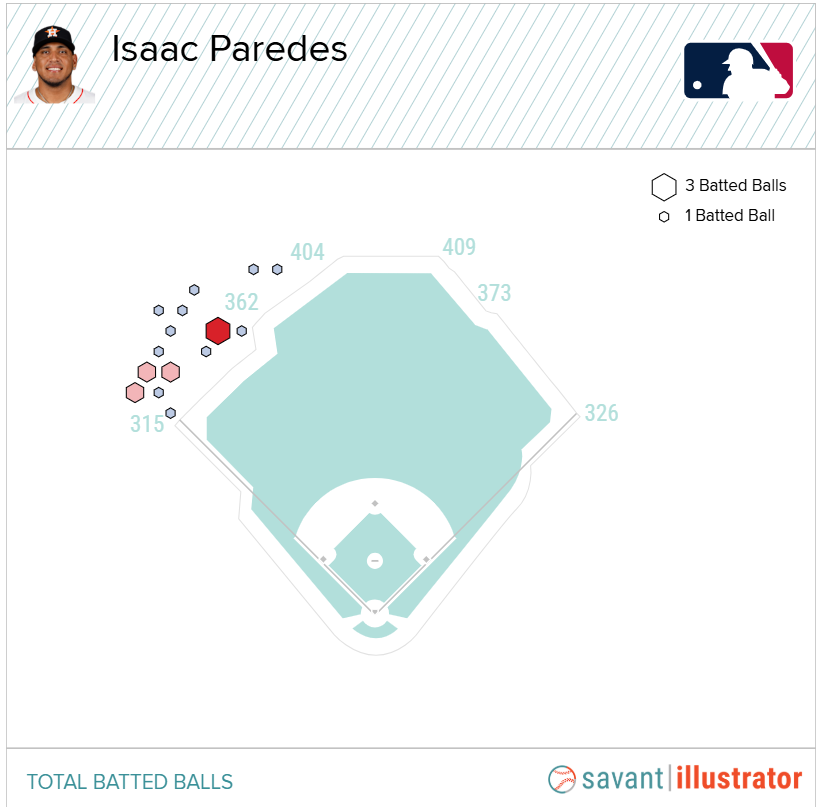
Only a handful of major league teams have a short left field porch. Thus, the can project Paredes to hit fewer homers for their franchise than can the Astros. Paredes may address their potential issues at third base, but they will discount that contribution more than Dana Brown.
We do know the Red Sox were interested in Paredes, and there was discussion of a three-way deal where Paredes ended up in Boston and Brendan Donovan of the Cardinals ended up in Houston. The Red Sox also have a short left field porch—the Green Monster. But the trade never happened. Donovan was traded to the Mariners, where he is likely to be their third baseman and leadoff hitter. And the Red Sox addressed their need for another infielder by getting Caleb Durbin from the Brewers. However far trade talks with the Red Sox got, Dana Brown was not able to complete them.
The Awkward Fit
The inability of the front office to resolve the logjam at corner infield so far has led to a Spring Training where both Walker and Paredes have had to answer awkward questions about potentially being traded. Both have answered professionally and thus have tamped down immediate stories about how the clubhouse is reacting to the trade rumors. But those stories will return, even if later.
There is an awkward solution to the corner logjam. It involves keeping Correa at third base and Walker at first base. Paredes would serve as the DH and Yordan Alvarez could then start in left field. After all, the trade target for the front office in a Paredes trade is a lefty hitting corner outfield, and you won’t find a better lefty swing than Alvarez’s.
I noted this possibility in analyzing the Jesus Sanchez-Joey Loperfido deal. In that swap, the Astros traded away their projected starting left fielder for a less player. They also achieved the savings they wanted to meet Jim Crane’s budget target—savings they may have early projected to come from a trade of Walker.
This defensive configuration works in the sense that you can get all of the Astros best players into the same lineup. It’s a defensive downgrade—Paredes is a good to average defender depending on your metric while Yordan lacks the lateral quickness to be a good outfielder.
The bigger concerns with this defensive arrangement is with Joe Espada’s expressed desire this offseason to limit Alvarez’s time in the outfield. Alvarez pushed back against that today in West Palm Beach, saying through an interpreter “All my injuries have been from different ways (and) running. But I haven’t had any serious injuries actually playing left field.”
Dana Brown and the front office have painted themselves into a corner, unable to resolve the logjam in the corner outfield. Yordan Alvarez may be offering them a lifeline. We will see if they take it.
“But neither Gurriel, Trey Mancini*, nor Jose Abreu were able to provide useful offensive or defensive skills at first base.” (*Though we greatly appreciate his very useful defensive skills that miraculously emerged in the 8th inning in the 2022 World Series.)