
Hunter Brown’s Innings Problem Is the Astros’ Season
Innings limit and velocity concerns

”Pitchers leaning on sinkers or fastballs for over 48% of their pitches see UCL injury odds rise by 2% per additional percentage point above that threshold. Each 1 mph increase in average sinker velocity further boosts those odds by 30%, amplifying arm stress in long outings.” - Twins Dailty
Hunter Brown didn’t hit an innings wall last year because he wasn’t built for it.
Going into this season, the team is not longer lineup first. Once again, they’re a run prevention team that has to win games literally by keeping them on the ground (naturally with a sinker or changeup).
That only works if someone is absorbing innings at the top of the rotation, because everything behind it is thinner than the name value suggests. In 2025, Hunter Brown became that guy.
The cleanest example is April 21 against Toronto: seven shutout innings, two hits, nine strikeouts, 96 pitches. It was a functional outing, not one for the ages. It was the kind of start that resets the bullpen and makes the next three days possible. Those are the starts we used to get from Valdez from Verlander without thinking about it. Now they’re rare enough that one of them can change the shape of a month.
That’s what Brown became early last season: the pitcher who made the team feel normal and remained elite at over 9)7 mph,an averagge 95.7 mph (a +0.1 mph tick up from 2024's 95.6 mph
When he’s at full strength, the sinker the mechanism that lets him pitch deep while keeping his pitch coun lowt. When the velo drops even slightly, the pitch stops behaving like a ground-ball generator.
That’s where the Astros’ 2026 problem starts.
If Brown throws 190 innings again, that is a welcome gift. Not because he’s Tarik Skubal, of the Detroit Skubals (I had to go there), but because he’s the only starter on the staff who can keep the bullpen from becoming a nightly emergency.
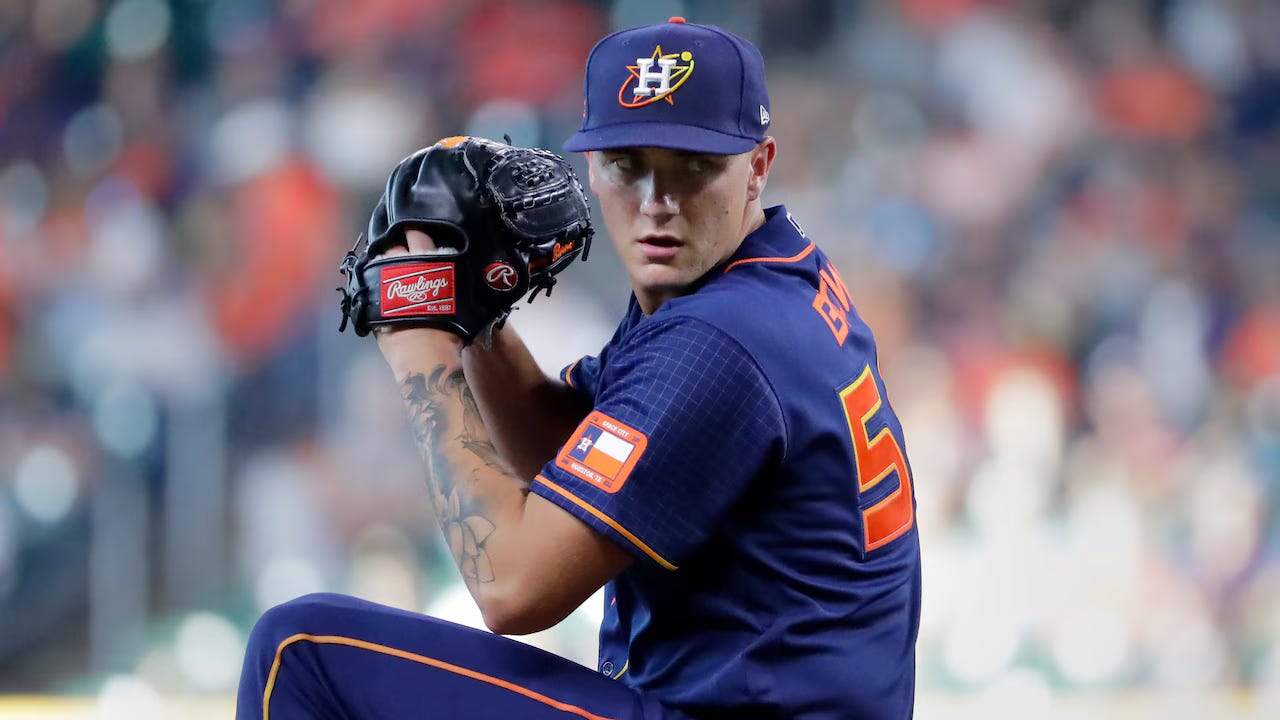
A slower sinker velocity reduces swing-and-miss potential and increases hard contact risk, as seen in other pitchers (Luis Castillo, Chris Bassit and Jose Siriano) who lost velocity and saw ERA spikes. Brown's early gain to 96.9 mph boosted his K% by 3.1%; a reversal might limit his (what could have been Cy Young if he had run support) performance (2.43 ERA).
If Brown is managed carefully, the innings won’t disappear and they will continue to carry the same impact. He’s the last remaining pitcher on the roster who delivered 185.1 IP (8th in AL) and 206 K’s last year while the rotation managed only ~1,200 total IP across 15 starters amid 7 IL stints.
To keep his inning below 185 IP in 2025), the rotation would need other starters to cover an extra 30-50 IP collectively. This maintains ~880-900 starter IP total while targeting sustainable workloads like 160-170 IP
Think about catching a full seventh inning in those May nail-biters, no endless camera shots of Abreu loosening up for the second time or Hader pacing early. Then fast forward to August, where the bullpen's grinding because nobody expects the bats to provide breathing room on this lockdown squad.
For that impact to carry into 2026 Spring Training, skip the 107-pitch limits entirely.
LESS THAT TWO WEEKS UNTIL PITCHERS AND CATCHERS!
NO AI SLOPI appreciate the support during this tumultuous time with a personal aoouncement coming soon as the robots get challenged: https://www.paypal.com/paypalme/hughan