
Has the Pitching Gotten Better? It's Complicated
The Astros are no longer among the worst pitching staffs in the majors. But the numbers indicate they have pitching in some good fortune recently, and that may not continue.

The Astros season hit its low water mark on May 14, as the team lost 8-3 to the Mariners. The loss—the 7th in a 10-game stretch—dropped the Astros to 17-28.
Since then, the Astros have stopped their early season freefall, going 25-16 in the 41 games since May 14. In a weak American League, that puts the Astros only one game out of the AL West lead and a half a game out of a wild card berth.
This isn’t quite the turnaround we saw in 2024 season when the Astros went from a 7-19 start to an easy division win. But the second quarter of the season has been distinctly different from the first.
The Astros issue in early part of the season was the pitching. On May 14, the Astros had a team ERA of 5.59. The printable sabermetric term for that ERA is godawful. Other terms came to my mind, as I’m sure came to yours.
If the Astros have turned around their season, it is because the pitching?
Fewer Runs Allowed
The short answer is “sort of.” The easiest way to see that the run prevention is improved is via the figure below. This is a 10 game moving average, which reduces day-by-day noise while still accounting for medium-term trends.
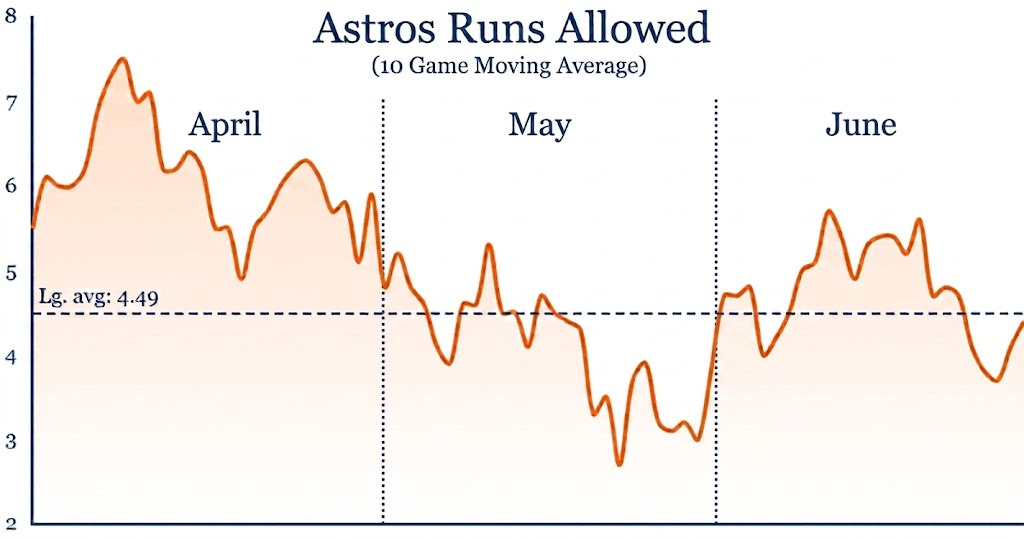
I added a horizontal line at 4.49, the league average. The Astros were terrible at run prevention early in the season, especially in the first few weeks of the season when the average peaked at over 7 runs per game. Then the run prevention got much better in the latter half of May before climbing back up in June, though nowhere near the catastrophic levels of April. There are a lot of bumps and wiggles to this figure, but it tells a story of improved pitching for the Astros.
How improved is it? The table below takes 5 key pitching stats and compares how the Astros did through the May 14 loss and after. It’s quite a difference.
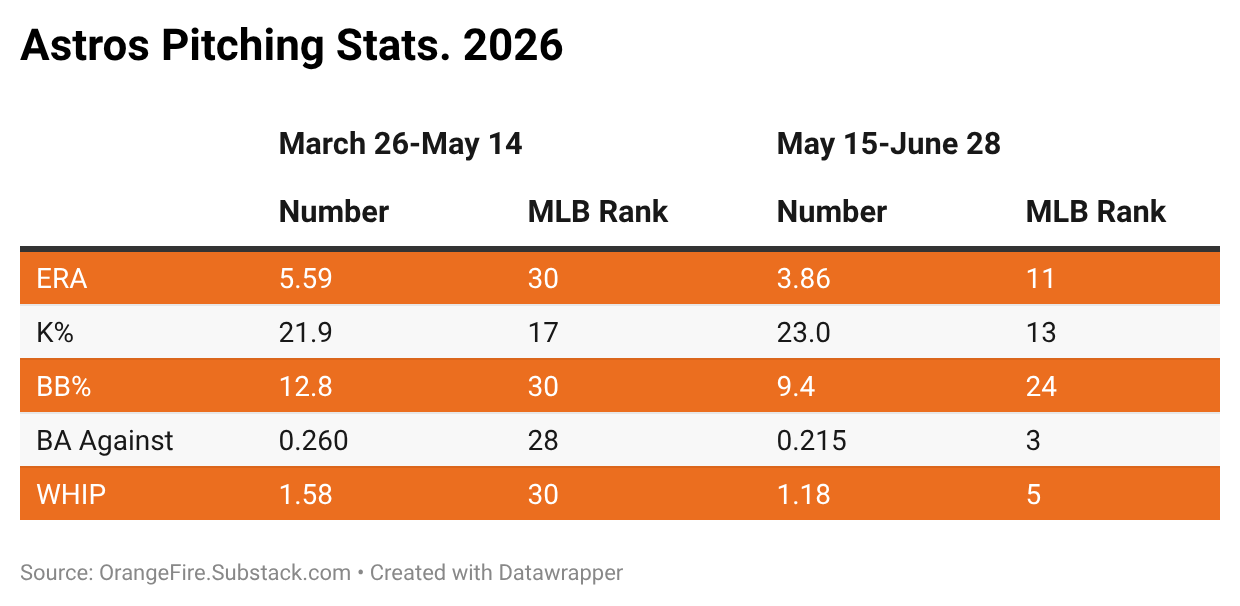
The most obvious way to see the improvement is via ERA. The Astros were the worst pitching staff in the majors through May 14, allowing 5.59 earned runs per nine. They have dropped that to 3.86 since then.
Astros pitchers have dropped the batting average they allow. It was .260 through May 14 and is .215 since then. The reduction in hits shows up in WHIP (walks and hits per innings pitched), which has gone from 1.58 to 1.18. In the early part of the season, these marks were in the bottom three of the league. Since then, they have moved all the way up to top 5.
There are more modest changes in the team’s strikeout and walk rates. Astros pitchers are walking 3.4% fewer batters since May 14. That’s a big improvement, but the fact that it has reduced their MLB rank only to 24th shows how high the walk rate was early in the season. The strikeout rate has improved modestly, going from 21.9% to 23.0%.
It is a striking improvement in run prevention, the most important job for a pitching staff. But the improvement primarily comes from something for which a pitcher has modest control—the number of base hits allowed—than from the things for which pitchers have greater control—strikeouts and walks.
How Strong is the Improvement?
These numbers raise a question. Was the pitching improvement illusory? Was it just the product of good fortune, as more balls that found holes in the first part of the season are now finding gloves in the second part? I examined some more advanced pitching metrics in the table below.
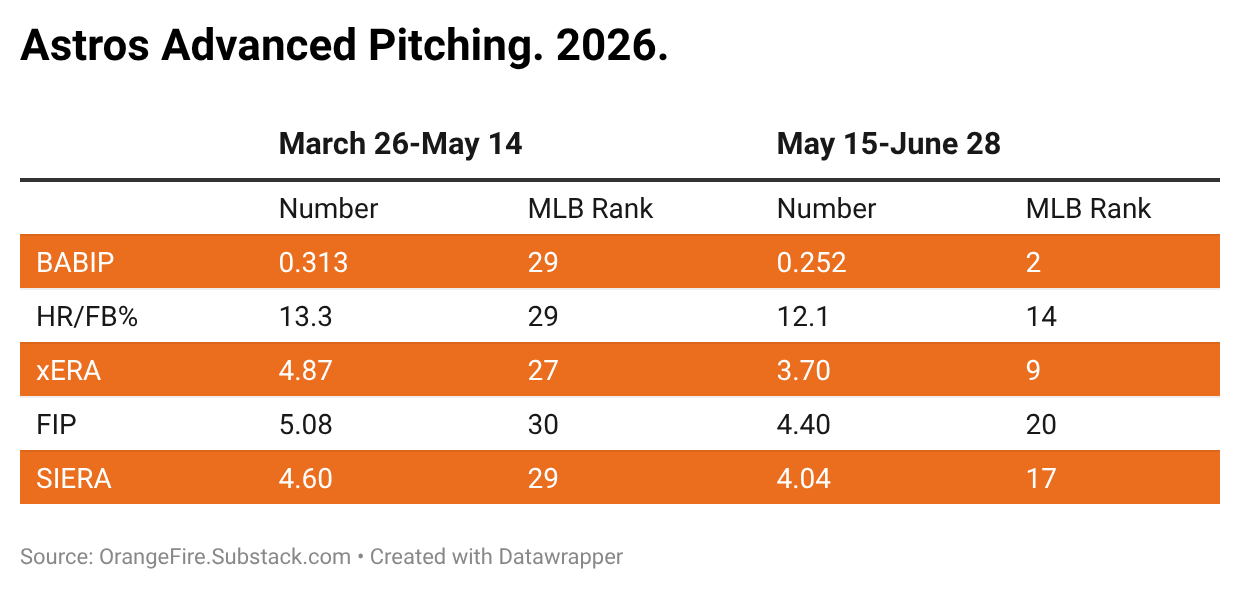
It paints a more complicated picture than in the first table.
BABIP, which stands for Batting Average on Balls in Play, measures the share of balls hit into the field of play (i.e. no strikeouts or home runs) that end up as a hit. Astros pitchers had the second worst BABIP through May 14 and the second best since then.
Sabrmetric analysis has traditionally regarded BABIP as a measure of fortune. When BABIP is high (the current league average is .287), it tends to come down in the future. When it is low, it tends to go up. It usually doesn’t work in the extremes we see with the Astros pitching staff this season, but it fits the pattern.
Another data point often used to measure pitching luck is Home Runs per Fly Ball %. High numbers tend to come down over time. We see that with the Astros, though the change is not as stark as the one we saw for BABIP. The Astros have moved from 29th in this measure to 14th since May 14; an improvement, but one to the middle.
I also looked at three different ERA estimators—xERA, FIP, and SIERA. I won’t get into the details of the differences between these three. What you need to know is that each tries to explain how well or poorly a team is pitching while removing the effects of good or bad fortune.
All three tell the same story. The Astros were among the worst pitching staffs in the majors in the first 45 games of the season. They may have had some bad luck due to a poor BABIP, but that only exacerbated the poor pitching the team received.
Since May 14, the pitching is better, but that improvement tends to be toward the middle of the pack. You can choose your own adventure if you want to say the Astros are in the front half of pitching staffs (xERA has them 9th best after May 14) or in the back half (FIP has them at 20th). But they are no longer among the worst staffs.
The issue is that these metrics are clear that the Astros are not among the best pitching staffs in baseball. The reason is simple. The Astros walk a lot of batters—something that has been consistent across the 2020s for the Astros. But they are only in mid-pack when it comes to strikeouts. The dominant Astros pitching staffs of the early part of this decade tended to be among the top teams in baseball at striking out batters.

Looking Forward
I started with the question of whether the Astros pitching staff had gotten better and if that was responsible for the team’s turnaround in the second half of the season. The simplest answer is yes. The team is allowing fewer runs per game and good way to win baseball games is to reduce the number of runs your team allows.
But it is clear that the team is pitching in some good fortune since the season bottomed out on May 14. Batted balls that tended to find outfield grass in the first quarter of the season are finding gloves in the second half of the season. That has been a big help.
Also helping is the reduction in walk rate. This Astros team is never likely to be in the top half of the league in walk rate, but the reduction in walks since May 14 has been key to the improved pitching performance. Unfortunately, it has not been joined by a big jump in strikeouts.
That leads to the question of where the pitching staff will go in the second half of the season. Thanks to a tepid American League, the Astros are in playoff contention even though they are right around .500. If the pitching staff regresses to what we saw in the first quarter of the season, then the team’s record is likely to regress as well.
That seems unlikely. The pitching staff is improved since the first quarter and is not likely to pitch with such bad fortune as they did then. The staff is healthier, with Hunter Brown and Josh Hader back from the IL, and better pitchers should help them avoid the lows of April.
But the ERA estimators and BABIP numbers indicate that this team has pitched in some good fortune over the second quarter of the season. That is also not likely to continue.
This pitching staff seems to be a mid-tier staff among major league teams in the 2026. The big remaining question seems to be if they can be toward the top of that mid-tier, or toward the bottom. If they stay toward the top—and I wouldn’t turn down some BABIP and HR/FB% fortune to get them there—they can make the playoffs. But that’s is of course a big if.
Absolutelynone of the young talent currently on the Astros will ever be anything other than a backup player.