
Carlos Correa, Third Base, and the Quiet Work of Staying Available
Designing longevity for the middle infield

There’s a version of this conversation that turns into a debate about range charts and positional value. That’s not the useful one.
The real question isn’t whether Carlos Correa can still play shortstop. It’s how long you want him absorbing the daily cost of it.
Correa has made nearly 1,200 defensive starts at shortstop in his career. That’s not just mileage. It’s a repetition of the most physically demanding movements an infielder makes: lateral bursts, off-balance throws, violent rotation through the torso, and resets that happen while the body is already moving.
Shortstop doesn’t just demand more range. It demands more throws made across the body, under time pressure, without a clean base. Over time, that stress doesn’t announce itself all at once. It shows up as missed games, shortened stretches, and the kind of “maintenance” that quietly eats into availability.
Moving Correa to third base is about reducing how much the body has to absorb each day.
He’ll still play some shortstop. What changes is the toll. Third base asks for fewer emergency throws, less repeated rotation, and fewer plays where the body has to create force while already compromised. Even small reductions compound over a season.
That context matters when you look at the black brace Correa wore between innings.
It wasn’t decorative. It wasn’t a rehab device. It was a rigid core and rib stabiliser, designed to limit excessive rotation while keeping the area warm and supported. Infield throws, especially at shortstop, load the obliques, lower ribs, and spine over and over. The brace doesn’t remove that stress. It dampens it. It reduces the amount of twist the body has to absorb on each repetition, over the course of a game and eventually a season.
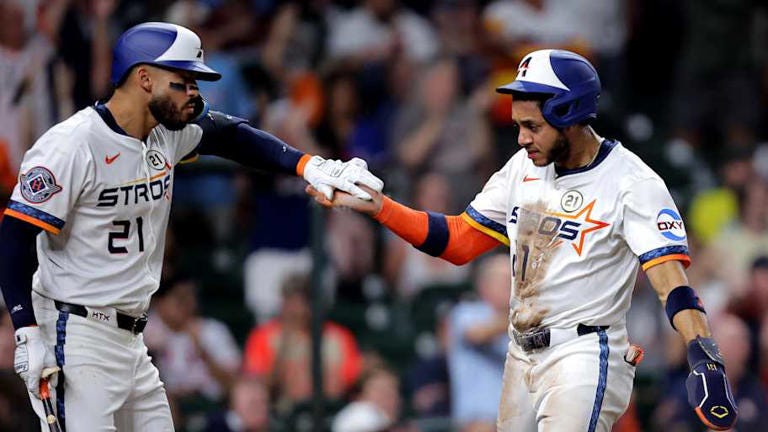
Veteran infielders have used versions of these for years. You’ve seen them on players like Nolan Arenado, Manny Machado, and Justin Turner during stretches where they were healthy enough to play but managing accumulated strain. It’s a load-management tool, not a warning sign.
This isn’t new thinking for Correa. In Minnesota, he pushed for a move to third base, but the Twins’ roster construction never made it workable. Royce Lewis was central to their long-term infield plans, effectively keeping Correa at short.
Houston’s alignment gives him more room.
Jeremy Peña remains the everyday shortstop. Correa doesn’t need to replace him to matter there. The healthiest version of this is third base as routine and shortstop as rotation: a few series spelling Peña, the occasional late inning, the emergency start, then back to third before the toll accumulates.
That usage protects availability without forcing a position change to carry symbolic weight.
It also intersects cleanly with the rest of the roster. Isaac Paredes complicates the picture without changing the premise. His hamstring questions linger, and Yordan Álvarez already speaks for the DH lane. That leaves first, second, or movement. Those are roster construction questions. Correa at third is a health question.
Correa came back to win, and he came back at a moment when the Astros still had a real chance to make the postseason, before the roster slipped into triage mode.
This is the last season before the next CBA. It’s the last clean runway where teams can make decisions without hedging against future rules or payroll structures. The opportunity isn’t in one headline move. It’s in the quiet ones around the edges, the decisions that don’t show up in March but change how the season feels in August.
It applies to pitching, too, where depth always looks excessive in December and never looks sufficient by mid-May.
Longevity doesn’t come from playing less. It comes from paying a smaller toll each day.
Until tomorrow…