
Can Cam Smith Anchor RF or Force a Trade?
Astros’ Outfield Gamble

The Astros didn’t lose 2025 because it lacked talent. It lost because the roster couldn’t stay on the field long enough for talent to matter. They used 15 starting pitchers. By August, the season wasn’t being managed so much as survived. That context matters because it’s the real reason Cam Smith matters. it matters because the Astros are no longer built to carry uncertainty in the corners. They are built to carry defined roles, and last season stripped those roles down to nothing.
Beyond advanced metrics and versatility, consider Smith’s age-adjusted development curve. At 22 in a sink-or-swim promotion, his .479 OPS second half aligns with typical adjustment periods for college draftees facing MLB velocity—evidenced by peers like Jackson Merrill rebounding post-rookie dips. Astros’ analytics-driven coaching (e.g., hitting tweaks from Sean O’Hare) targets swing decisions, where his 65% zone contact held steady but chase rate spiked 4% late-season. Paired with Minute Maid Park’s RF dimensions suiting his opposite-field power, this positions him as a low-cost 2-3 WAR anchor rather than trade chip.
Smith is the closest thing Houston has to a structural fix that doesn’t cost money within free agency They didn’t go enter 2025 with an outfield crisis. They went into it with an outfield that only worked if everyone stayed healthy and every contingency plan stayed theoretical.
It didn’t.
Yordan Álvarez missed time. José Altuve needed more rest and more DH days. The depth behind the starters wasn’t playable over weeks, only over days. That’s how the season unraveled. Not through one injury, but through the moment the roster stopped having any functional second options.
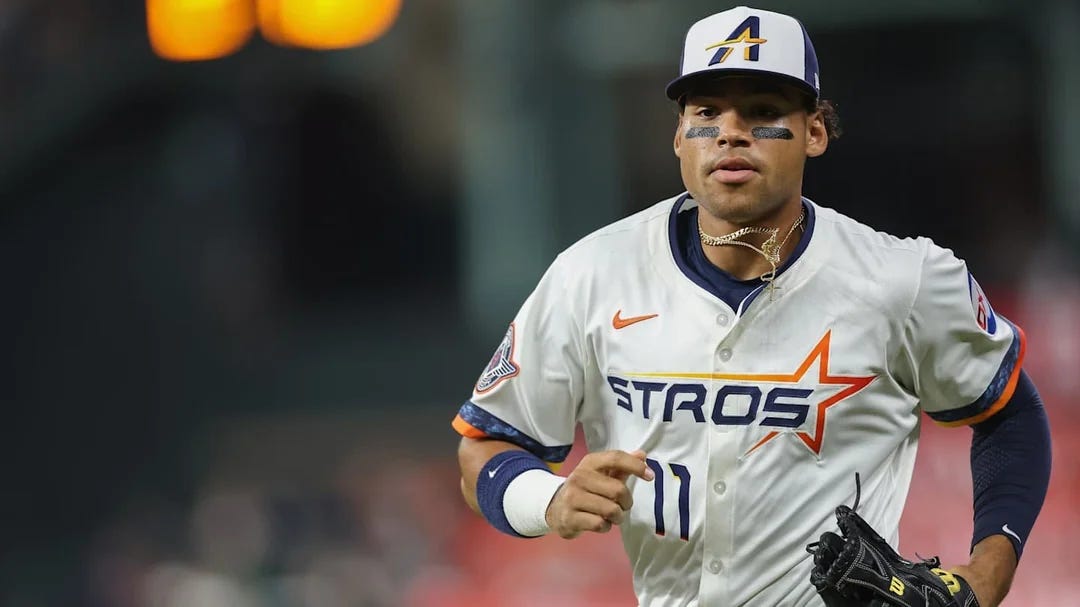
By midseason, the outfield wasn’t a lineup decision. It was a patchwork. That’s the environment Smith debuted into and his season is easy to summarize badly.
He opened hot, hitting .292/.361/.440 over his first 75 games. He looked like an instant win. A real bat. A player whose presence made the roster easier to build. Then the second half hit. Over his final 59 games, he ran a .479 OPS and looked like a hitter who had been mapped.
Overall, the full rookie line is less flattering: .236/.312/.358, 9 home runs, 493 plate appearances, a 90 wRC+.
That is not an anchor profile. But it also wasn’t a meaningless season. Smith was a Gold Glove finalist in right field, and that detail changes how the entire evaluation works. If he had been a bat-only rookie who cratered late, this would be a simple story. He isn’t.
Objectively, the team didn’t get a failed hitter. It got a defense-first regular who might still become a hitter. That is a different asset. Notably, Smith’s defensive value is what makes him difficult to move and difficult to ignore.
Right field defense is one of the few places where a player can provide real value without being above-average at the plate.They just lived the version of the season where they didn’t have enough stability anywhere else to let defense carry.
If Smith can hold right field at a high level, he buys the team something the roster didn’t have in 2025: a position that doesn’t require constant adjustment. That’s why Dana Brown’s messaging has been so pointed. “More consistent” isn’t a vague critique. It’s a roster instruction. The front office isn’t asking Smith to become a middle-of-the-order hitter. They’re asking him to stop disappearing for two months at a time.
Because the roster can’t afford another position that goes dead. This is the part that gets missed in the usual rookie narrative. He wasn’t promoted because the Astros wanted to see what they had. He was promoted because the organization didn’t have a better option, and by July it was clear that the outfield was going to determine whether they could survive the season.
When Smith collapsed offensively in the second half, they team didn’t just lose production. It lost the ability to treat right field as solved. That rippled into everything else: DH usage, rest days, matchup lineups, bench composition.
It also quietly boxed the front office in at the deadline, Brown couldn’t trade from the outfield if the outfield wasn’t stable. They couldn’t trade for pitching without knowing whether Smith could hold a lineup spot.
That is what “development” looks like in a season like this. It isn’t optional. It becomes the constraint. So far, the offseason didn’t create flexibility. It created commitments to the infield. That leaves right field as the one spot that can either stabilize the roster or destabilize it.
ZiPS projects Smith for 434 plate appearances and a .243 average with a .731 OPS. That’s not star-level. But paired with plus defense, it’s a real everyday player.
They need him to be reliable and if Smith rebounds in spring and looks like the hitter from April and May, the Astros can build the roster cleanly.
That’s a coherent outfield. It gives the roster enough structure to survive injuries without improvising every day. The other scenario is uglier.
If Smith’s bat stays at 2025 second-half levels, Houston is left with a defense first right fielder who cannot justify everyday plate appearances. That forces a decision, because the roster doesn’t have enough flexibility to hide him. At that point, they have to do one of two things. They either trade from the outfield, likely Meyers, and accept the defensive hit in center.
Or they trade for a real outfield bat and push Smith into a part-time role. Either move costs something. That’s the point. The Astros don’t have free solutions anymore.
With little depth, Cam Smith isn’t being evaluated like a normal prospect. He is being evaluated as a structural piece. A player whose success or failure changes what the front office can do next.
That’s why the rookie line doesn’t settle the story. A 90 wRC+ rookie season is survivable. A Gold Glove-caliber right fielder is valuable. But a roster that just lived through 2025 can’t afford another position where the bat disappears and the depth behind it isn’t real.