
A Step Back Now. A Step Forward Later?
The Sanchez for Loperfido swap is a definite downgrade. But one can't judge this trade without evaluating the next move that this one set up.

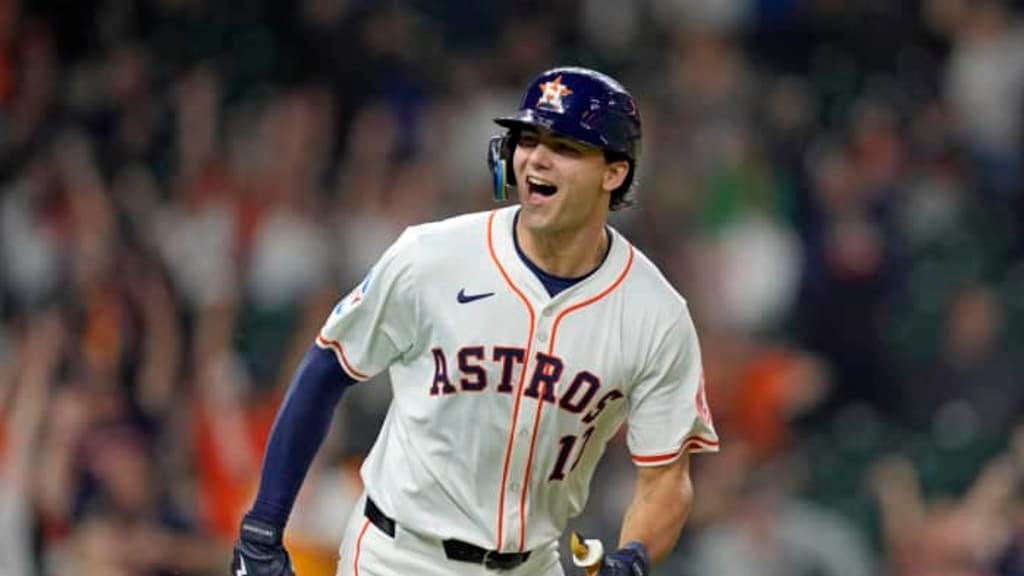
From a talent standpoint, the trade of Jesus Sanchez for Joey Loperfido is a modest downgrade. The Astros are sending out a better player and receiving a lesser player back. A straight analysis of this deal for the Astros shows it is a loss for the team.
But the Astros front office did not make this deal for primarily to get Loperfido back on their roster. They made this move for payroll savings, and to open things up to make another move. The grade on this deal—at least until they make their other moves—is an incomplete.
We know the front office made this move to make another move because that’s what Dana Brown told us. In discussing the Sanchez-Loperfido swap yesterday in West Palm Beach, Brown said “We’re not done yet…This is just one of those moves that we’re locking.”
More is coming, and the next deal will go a long way to determining whether yesterday’s trade will work out or not.
The Swap
I’m pretty sure I am in the minority among Astros fans in seeing the Sanchez-Loperfido swap as a clear downgrade. I believe many Astros fans are basing their negative opinion of Sanchez’s talent based on his performance with the Astros in 2025. Sanchez slashed .199/.269/.342 in 160 plate appearances after coming over in a trade deadline deal from the Marlins. It was a big slump.
But baseball talent is not determined by the small sample size of two months. A better way to look at players, especially at the beginning of a season, is via their projections. For example, The Depth Charts projection from Fangraphs says Sanchez will slash .247/.314/.430 for a 107 wRC+. That’s 7% better than league average, and right along Sanchez’s career numbers. Sanchez is an average hitter at the plate, despite what we saw in Houston last season.
Compare that to Loperfido. That same projection system says that Loperfido will slash .238/.300/.389 in 2026. That’s worse than Sanchez on all three elements of the triple slash line.
Loperfido was quite good in the majors last season, slashing .333/.379/.500 in 104 major league plate appearances. Why aren’t projection systems picking up on Loperfido’s good year in 2025? Because he actually spent most of the year in AAA, where he slashed .264/.341/.401. That’s just above league average…in the minors.
That the Blue Jays kept Loperfido in the minors most of last season—and used him for only 1 plate appearance in their playoff run last season—is a sign that they evaluated him as a AAA player. Sanchez, despite his many flaws, is not.
The Value of Payroll Savings
Sanchez and the Astros avoided arbitration and settled on a $6.8 million contract. Loperfido will make $780,000 in 2026, which is the major league minimum. The Astros valued the payroll savings this trade created.
The Astros are less than $5 million from the luxury tax threshold of $244 million, and several reports indicate that Jim Crane is not willing to pay the luxury tax for the third season in a row. Being that close to the luxury tax threshold reduces the ability of the Astros to maneuver over the course of the season, as they will add to their payroll as they call players up or sign free agents to cover injuries across the season. They also lack the payroll space to add much at the trade deadline. Again, Jim Craine could increase the budget if he chooses, but so far he seems committed to setting the payroll at the luxury tax threshold.
What’s the Next Move?
What move might the Astros make? One is very obvious. They could use a backup catcher. At the moment, they have only two catchers on their 40-man roster. Yainer Diez will be the starter, but Joe Espada has shown little faith in Cesar Salazar. An upgrade here is possible.
One possibility here is Christian Vazquez, late of the Twins and before that the 2022 Astros. Chandler Rome reported on the Astros “interest” in Vazquez in late January. Vazquez remains a free agent, so he is still available if the Astros want to increase their interest in him.
Of course, that’s not the move most Astros fans were thinking about when they saw that Jesus Sanchez was traded. Instead, they were thinking of about a larger deal that would clear the logjam in the infield and address the need for a left handed hitter. A left-handed hitter who is better than Loperfido.
Brown addressed that as well in his remarks to the media yesterda. “I won’t get into any specifics, but we’re definitely having a lot of conversations, and we’re still focused on left-handed bats.”
The Astros have been looking to trade Christian Walker all offseason in an effort to alleviate the logjam created at corner infield when they acquired Carlos Correa to play third base at last season’s trade deadline. But the team has not been able to find a taker for Walker, even assuming that the Astros will pay a large part of his salary. Yesterday’s deal may be recognition that the front office cannot achieve their payroll savings through a Walker trade.
If they cannot trade Walker, the Astros have explored trading Isaac Paredes. While Walker’s contract is underwater and would not fetch a meaningful return, Paredes holds value across the majors. Other teams have engaged the Astros in trade talks. But none have come to pass.
The advantage of trading Paredes is that you can get back a meaningful return, someone who can help the Astros in 2026. And the Astros biggest hole right now is a left-handed hitting corner outfielder.
Perhaps this is a sign that a trade of Paredes is imminent. Maybe.
Yordan the Left Fielder?
There is one other move the Astros could make before the 2026 season begins. And that is to make no move at all. Instead, they could start Opening Day with Correa at third, Walker at first, Paredes as the designated hitter, and Yordan Alvarez in left field.
Alvarez is a better hitter than anyone the Astros could acquire in a deal for Paredes. And we have seen each of those players play a lot in those positions. It could work.
Well, it could work out if Alvarez can withstand the rigors of playing in the outfield most days this season. Which is a dubious proposition. Joe Espada has talked this offseason about reducing the innings Alvarez plays in the field to take some burden off of his body, and to let him do what he does best—play with a bat in his hands.
Yet, yesterday’s move puts the Astros closer to a scenario where Alvarez is the Opening Day left fielder as part of the only way to get him, Paredes, Correa, and Walker into the lineup. If you were playing a computer game, that would be your optimal lineup. But one can turn off injuries in computer games. That setting is not available for Joe Espada and Dana Brown.
It is more likely that the front office wants to make a trade that resolves the logjam in the corner infield without making Yordan Alvarez a full time outfielder.
But yesterday’s trade makes that more likely. Another move is likely to come. Yet, the longer it goes without that move happening, the more likely it is that there is not move before Opening Day.